


I’m an independent author, meaning I don’t have a publicist or a PR team, and I have a small budget when it comes to marketing my book. However, that’s not going to stop me from doing the things authors with entire companies behind them get to do.
Bootstrapping it is!
I’ve always wanted to be interviewed about this book and to sit down and talk about the creative process behind birthing this story. Instead of sitting up here waiting for a phone call that probably was never coming, I just went on ahead and interviewed myself.
Since the book revolves around the number twelve—twelve seats at the table of power—it felt right to match it.
So, here ya go: a dozen questions about my debut novel, The Art of Killing Gods.
1. What’s the book about?
The story follows this photographer named Jaden, who spent his whole life trying to get out of the projects where he grew up. Along the way, he discovers that the Greek gods are real. And they’re running the world.
Which is how he ends up pulled into an empire coming apart, one that mistakes him for a pawn. The gods have no idea that Jaden’s mom took a secret to her grave. Someone does, though, but they’re not saying what it’s going to cost Jaden.
2. Where does this story take place?
Of course we get tours of the cool mythic spots like Mount Olympus and the Underworld, but the story is grounded in two very real places: Richmond, Virginia, where Jaden grows up, and Amsterdam, Netherlands, where he encounters the gods living among us.
3. Why is it set in the present day instead of ancient Greece?
I’ve always loved juxtaposition, and that’s manifested in this book by taking something ancient and dropping it into a modern setting. I really wanted this story to showcase how timeless some of the themes underneath these old stories could be. When it comes to privilege and power and who gets to struggle vs. who doesn’t, these themes hit even harder if we put a fresh coat of paint on the the story’s set dressing.
That’s why Zeus gets to live a full 1% lifestyle as king of the gods, jetsetting around the world, while some of the less powerful deities are splitting ambrosia with roommates just to get by.
4. Who is Jaden Pierce?
He’s this creative kid who grew up in the hood and spent his whole life watching from just outside the frame, more comfortable being behind his camera than in front of it. Jaden spends a lot of time figuring out where he belongs, and he has no idea he’s about to become part of the story instead of just the one holding the camera.
5. Who narrates the book? Why?
Dionysus does. I needed someone who would be able to provide an insider’s view into divine life but still dip into the mortal world. He was the perfect character to use for that dual perspective because of his parentage. His mom is mortal and his dad is Zeus.
I also wanted a character who would just make Greek mythology fun whether it’s something you’re already familiar with or this is your first exposure to it.
And being the god of wine, theater, ritual madness, and insanity, gave me a lot to work with and made for some electric scenes.
6. Who was your favorite god to write and why?
Oh, easy. Dionysus again. Which is why I made him the narrator. Out of all the gods, he felt the most vulnerable to write. His whole domain is letting go completely—ritual madness. And there’s something raw about building a character around that.
He starts the book snobbish, elitist, and a little unaware of his privilege in life. And wine brings out this frenzied, destructive side that does a lot of damage to the relationships in his orbit, especially with Pan, his sidekick and partner in chaos, gassing him up. The pair of them bring out each other’s wild sides.
But Dionysus has this arc that’s enlightening and humorous (if at times chaotic) to witness. At the center of it, he’s willing to change for the most important people in his life. Writing that metamorphosis was some of the most fun I had in the entire book.
Runner up: Hades, who we’ll see more of in book 2!
7. Why did you write this book?
I fell in love with Greek myth when I was in high school, when I had to read The Odyssey for English class. It just resonated with me. In retrospect, I believe it’s because I’m always down for an epic journey or a quest of some sort, especially if there are fantastical elements along the way: a giant trying to gobble us up, Circe turning men into pigs, or the sirens tempting sailors with the songs and secrets of divine knowledge. Something about these elements is both alien to the world we live in yet completely relatable as stand ins to highlight human struggles and temptations that all of us grapple with. Only with different costumes.
When I decided that I was going to be a writer, I knew that at some point I wanted to write a book in that world. I knew that I wanted to place it in a modern setting. And I wanted to use elements of Greek mythology to emphasize the human story underneath.
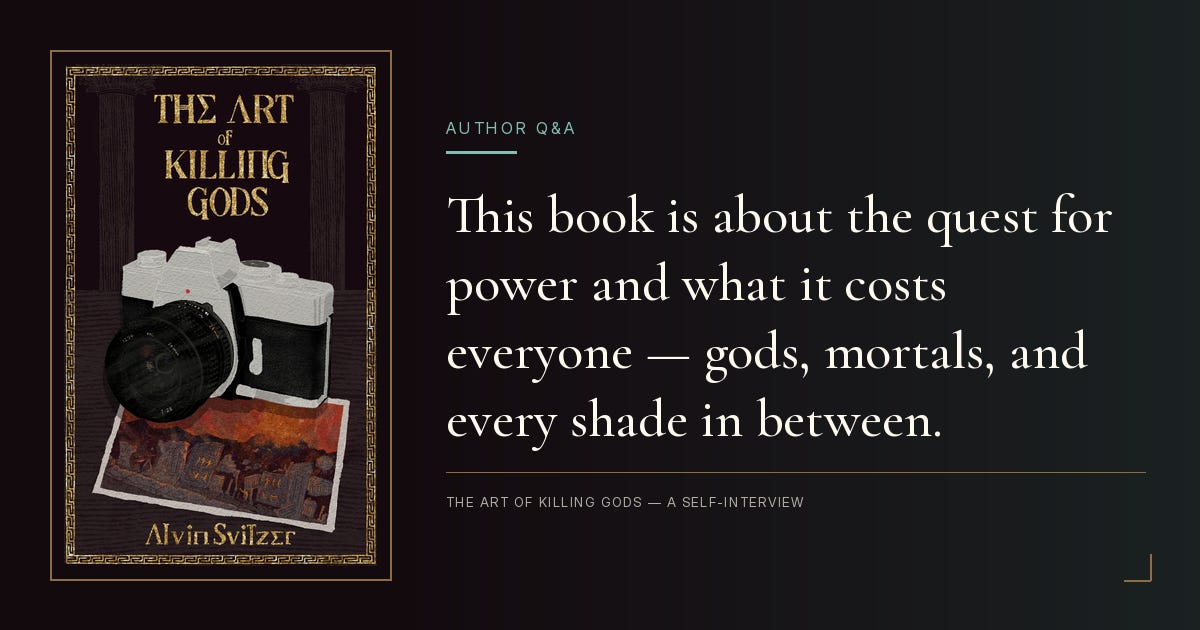
This book is about the quest for power and what it costs everyone—gods, mortals, and every shade in between. I thought that Greek mythology, with its inherent power imbalances, was a great tool for showcasing how there isn’t a safety net for people who fall through the cracks. And I wanted to sit with that.
8. What was scary about writing this book?
The Art of Killing Gods is not exactly fussy when it comes to introducing genres to its mechanics, and I was afraid about how many different elements I was pulling into the story. Obviously there’s folklore and mythology with the gods and monsters as characters. There’s urban fantasy as I’m placing all that into real cities like Richmond and Amsterdam.
There’s a romance thread built into the plot as my queer main character falls for the god Apollo. There’s also coming-of-age, since Jaden’s story is partly about growing up in the projects and learning which doors open and which get kicked in.
And underneath all of that, it’s still a character book first. It’s about developing characters who fall in love, fall out of love, fall through the cracks, and confront what it means to get left behind.
I was afraid that mixing all of that together meant nobody would connect with the story or that it would be a niche book. But if you like intriguing characters, snappy writing, and a story that’s going to make you laugh and cry and get a little frustrated along the way, then this one’s for you.
9. What’s the tone?
I guess it shouldn’t be a surprise that it’s kind of a mashup?
Take the zany factor of Greek mythology, throw in the punchiness of thriller stories, sprinkle in some Terry Pratchett satire—like what Good Omens does with the Christian religion, except I do it with power structures—and run it all through a Black perspective.
Blend that together and you get a kinetic read that’s hard to categorize.
10. Is it more fantasy or literary fiction?
It’s got a hefty dose of both but it’s fantasy first, literary second. The plot moves like a fantasy novel should. You know, we get stakes and mechanics to how the gods and their power actually work, but the writing leans literary because, at the end of the day, this is a character book before anything else.
11. What books is it similar to?
There’s some Circe in it. Madeleine Miller is very character-focused in her work, and so is this, though my story leans more political, more directly satirical of the gods and the systems that let them keep ruling.
There’s American Gods in the DNA too. Both are stories where gods operate in a modern setting and are in decline, yet are still trying to figure out how to stay relevant.
It’s also similar to N.K. Jemisin’s The City We Became. We’re both taking mythic frameworks and using them to dive into race and identity. Hers comes from the story of New York and the character of the city’s boroughs whereas mine comes from Greek mythology and the character of its various gods. And where her book tends to sit inside the weight of some of her themes, mine finds a bit more room to laugh along the way.
12. Where can I buy it?
Everywhere, really! Most importantly, you can skip the megastores and buy it directly from me on my author site.
Or if the stores are more your vibe, here ya go: Barnes & Noble, Kobo, Apple, Google, and Amazon.
P.S. — If you’ve got any of your own questions or you just want to talk more about gods behaving badly or writing in general, I’ve got a small Discord where I hang out with readers and other writers.
P.P.S. — New short story drops next month! All I can say for now is that Lamia’s very sorry about all this. She’s still doing it though…
