


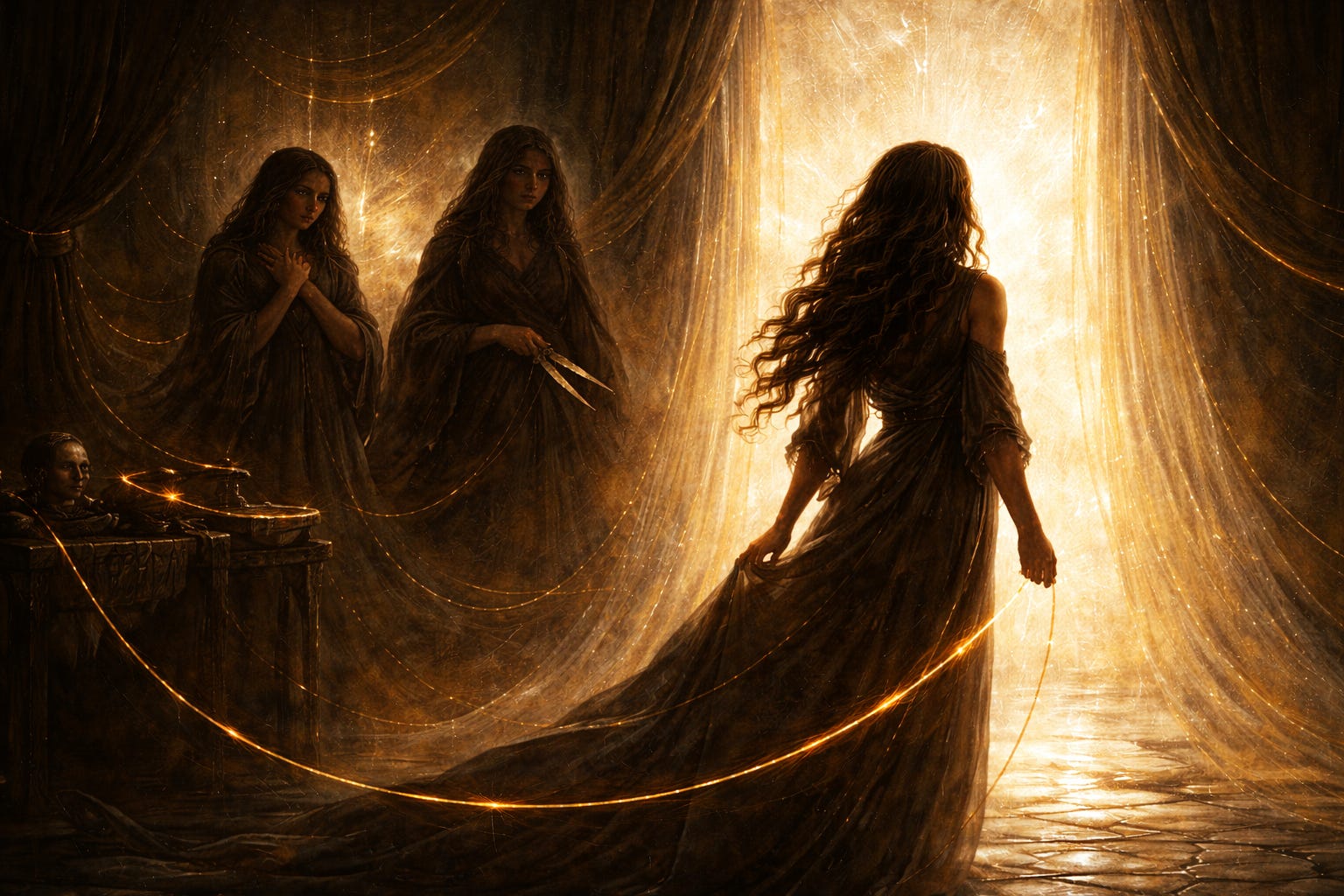
Before entering the final chapter, revisit parts 1 and 2, where a forbidden thread is pulled from the tapestry of fate—unbinding Lachesis from her ancient post and setting the inevitable into motion.


A Tapestry Rewoven
“It’s not forever,” Atropos said, finally breaking the silence. “It’s until you swear an oath on the River Styx.”
“Then let us talk,” Lachesis replied.
In a whirl of light, she was back in their sacred halls, unbound from those cold, molasses-slow moments, kneeling instead before her sisters who stood like sentinels—their forms hallowed by the ethereal glow of the tapestry.
“Essie, it’s time to return to us,” Clotho said as if they were finally done with all that, and the three of them could suddenly become this clean and new thing.
Of course, being there with them, a part of Lachesis wanted nothing more than that. As they stood near her, their presence was as familiar and constant as the sea. But something had shifted within her. Bound to the tapestry, she was no more than a tool. Her existence would always be shackled to someone else’s story.
“I’m not taking the oath.”
Atropos stepped closer toward her. “Let me explain more clearly, sister. Refuse this offer again, and you will be bound to the infinite shade. You will spend your eternity there. And if you change your heart on the matter, your pleas will be swallowed in that endless dark.”
Before her, Lachesis saw a mirror of herself in her sibling, like iron to iron, forged in the same fire. Neither one would turn around from the path they had set themselves upon.
But Lachesis had had time to think during her exile. “There is another way.”
At that, Atropos laughed—a sharp, brittle sound more akin to a blade scraping stone. Submission was never her way. To Atropos, the notion of a different path must have seemed like pure folly. A betrayal even, woven into defiance. Did she already see Lachesis as a loose thread that needed cutting before it could unravel everything?
“I’m not taking the oath because I will step down as one of the Moirai and live in the mortal world for the rest of my days,” Lachesis said.
“The mortal world?” Atropos all but spat. “Why would you go there?”
“We grant everyone the illusion of choice, but I’ve never had even that. For ages, I’ve watched the lives of others branch and bloom in directions they never anticipated while mine remains a closed loop. How can I remain here, shaping lives, when I’ve never truly lived one myself?”
“I think I understand,” Clotho said. “You seek a beginning of your own.”
“Of course you sympathize,” Atropos said. “You’ve always been too lenient with our sister, ever the rebel and over-bold. She may very well be seeking a beginning of her own, but we are servants of fate. This is our purpose, our creation. Not to be shied from or set aside lightly.”
Lachesis looked at her sister’s face, blazing with its righteous power. One of the Moirai. The Mistress of Shears, she is called. The Cutter, The Final Fate, Death’s Seamstress.
“Atropos,” Lachesis said.
“What?”
“What’s really going on?”
“Nothing.” The reply came too quickly, too sharp.
“Then why have you set yourself against me?”
Atropos turned to the tapestry, her jaw tightened. “Because you will die, sister,” she said at last. “I see it. I see it in the weave. These choices you are making take you closer to the end.”


Lachesis had expected fury, command, and perhaps even contempt. But this…this was something else entirely. “You’re afraid.”
“Do not twist my words. It is not fear; it is truth. The mortal world will tempt you, yes, but it will not care for you. You will inherit a flesh puppet, and you will inherit all the aches and humiliations that come with being bound to the decay of time, but it will happen slowly, then all at once, as first your infancy will not be the work of hours but years, inhibiting a pitiful state of helplessness where your only form of communication will be wails and whimpers, and when you finally grow up because puberty strikes, that beautiful black hair that you wear long and straight, this hair will betray you by thickening, hardening, and coiling uncontrollably, no matter how much you groom and tend to it. In your later years, your skin, once smooth, will crease—you will call it your badges of wisdom—as your body continues to become a vessel of rot, wrinkling and sagging, and you will become invisible, a relic that is both useless and irrelevant because as your body withers, so will the worth they place in you until even your thoughts are dismissed as outdated whispers, forgotten before you even speak them. Eventually, you will—”
“Oh, now, don’t be cruel,” Clotho interrupted.
Atropos stared at her. “I’m not being cruel…”
“She is being honest,” Lachesis finished for their sister. But she knew Atropos wielded truth like a blade—not to wound lightly but to cleave clean through. “And she is right. Those things will happen, sadly. But so will other things, beautiful things I have woven for others but never experienced for myself.” Her voice faltered, the words trembling on her lips. Lachesis swallowed hard, unsure why her heart seemed to crack beneath the weight of her own resolve. “This is what I want,” she continued, as though speaking to herself. “Even if I must endure the decay of time as the price.”
“Then you are a fool, sister.” Atropos brushed the edge of her shears with her fingers, testing their sharpness without thought.
Silence wove around them, as thick as the tapestry’s weave looming before them. And perhaps it gave Atropos a chance to finally notice Lachesis, and her consciousness must have stretched to remember their relationship. “But I suppose even fools have their threads,” she said, her voice a fraction quieter. “I know you think that I am heartless because I must kill. The truth is that not one of us asked for this job. And I know when it comes to death, all souls are siblings. Things end for everyone. But I thought…I thought we were the one exception. That the three of us would go on, the center would always hold. That we would always be the skilled, the masterful, we the great dealers of destiny. With memories of everyone’s lives, we would remain mighty spirits—stern siblings yet everlasting. Work is work, but the sisters I do it with are what made this role kind of a delightful disaster.”
It’s strange, Lachesis thought, how you can spend lifetimes beside someone, certain you’ve traced every edge and contour of their being, only to be startled by a moment that reveals entire worlds still hidden from view. Underneath the razor wire, there was a glimpse of something gentle. “Well, you could come with me. Nobody has given me permission aside from myself. I don’t see why you can’t do the same.”
“And allow these people to live forever?” Atropos sucked her teeth. “I don’t think so.”
“Maybe they wouldn’t,” Lachesis said. “Maybe they would tend to their own demise. Their path can be of their own will, not determined by three old crones.”
Atropos snapped her shears in the air. “I am not an old crone.”
“Besides, this is the work we were made for, and this is the work we’ll do. We can’t all run off.” Clotho gestured to the instruments of their eternal labor—spindle, rod, shears. “Without us, there would be too much chaos. Lives would be unchecked, destinies unfilled and such.”
Atropos turned her head ever so slightly as though the weight of the centuries shifted with her. “Sister, I never thought I’d see the day.”
“Oh, hush. This is not the first time I have agreed with you,” Clotho said, then turned toward Lachesis. “He will not be happy, you know. There may be consequences.”
An echo of laughter—Zeus’s mocking tone as lightning crackled at his fingertips—reverberated in Lachesis’s ears. The King of the Gods was not known for his tolerance of insubordination; his whims had orchestrated the rise and fall of heroes, the very threads she had measured and allotted.
Lachesis straightened her spine, letting a faint smile play on her lips. Was she not part of the ancient triad that even the gods respected, if not feared? Why should she, one of the weavers of fate, be ensnared by another’s design? “Let him rage on his crumbling throne. The tapestry is vast, and even gods cannot control every thread.”
“Since you’re going through with this, sister, you had better take this.” Atropos extended her hand, revealing a thread, uncurled and shimmering. “Your own fate, unbound by us.”
Lachesis stared, her eyes wide, her breath caught in her throat.
“Though I may not understand your choice,” Atropos said, “your happiness matters.”
Lachesis embraced Atropos, then pulled in Clotho, holding them both close. The scent of spun starlight locked them briefly together. “My beginning and my end.”
Clotho was the first to pull away. “Your thread isn’t completely unbound. I should warn you that I left a few things in there for you. Things I’ve learned from watching you.”
“Like what?”
“Well, not that you’ll remember this, but you will walk through city streets alive with movement, where voices rise in song and laughter, and you will lose yourself in the rhythm of its symphony. You will marvel at the first buds of spring breaking through Gaia and breathe in the crisp, electric air of autumn. You will weep for the fleeting beauty of a sunrise and break bread, soft and warm as though the hearth still clung to it. You will savor the sweetness of ripe fruit, feel the sea salt cling to your skin, and let the wind knot your hair without care. You will know the quiet joy of a child’s laughter and hold someone close enough to hear the unguarded cadence of their heart. You will love fiercely. And by the gods, I swear you will be loved in return.”
“And dancing,” Lachesis murmured as if lost in the dream already. “Will there be dancing?”
A smile—warm and radiant—graced Clotho’s features. “Of course, Essie. You will hear music not as an observer but as one who sways to its rhythm.”
Lachesis turned away from them to hide her tears, but the motion only sharpened the ache in her chest. She finally understood the crack in the wall of her resolve: this was the last time she would see her sisters.
The thought clawed at her, and she wanted nothing more than to embrace them a final time, to press them so tightly against her as to etch their shapes into her skin. But already, the veil beckoned, its pull undeniable. Already, the familiar hum of the spinning threads and the crisp snip of shears began to dissolve into the stillness. And each step toward the veil lightened her as though layers of ancient dust were peeling away, leaving behind something unmarked, something new.
“I will gather all these moments as treasures,” Lachesis called out to her fading sisters, “and stitch them into the tapestry of my soul.”
Fate has flair. Finish the story and wear your myth. Shop our Greek mythology gear inspired by the Moirai:
The stage is set, and the myth has been told, but the story isn't complete without your comments…