


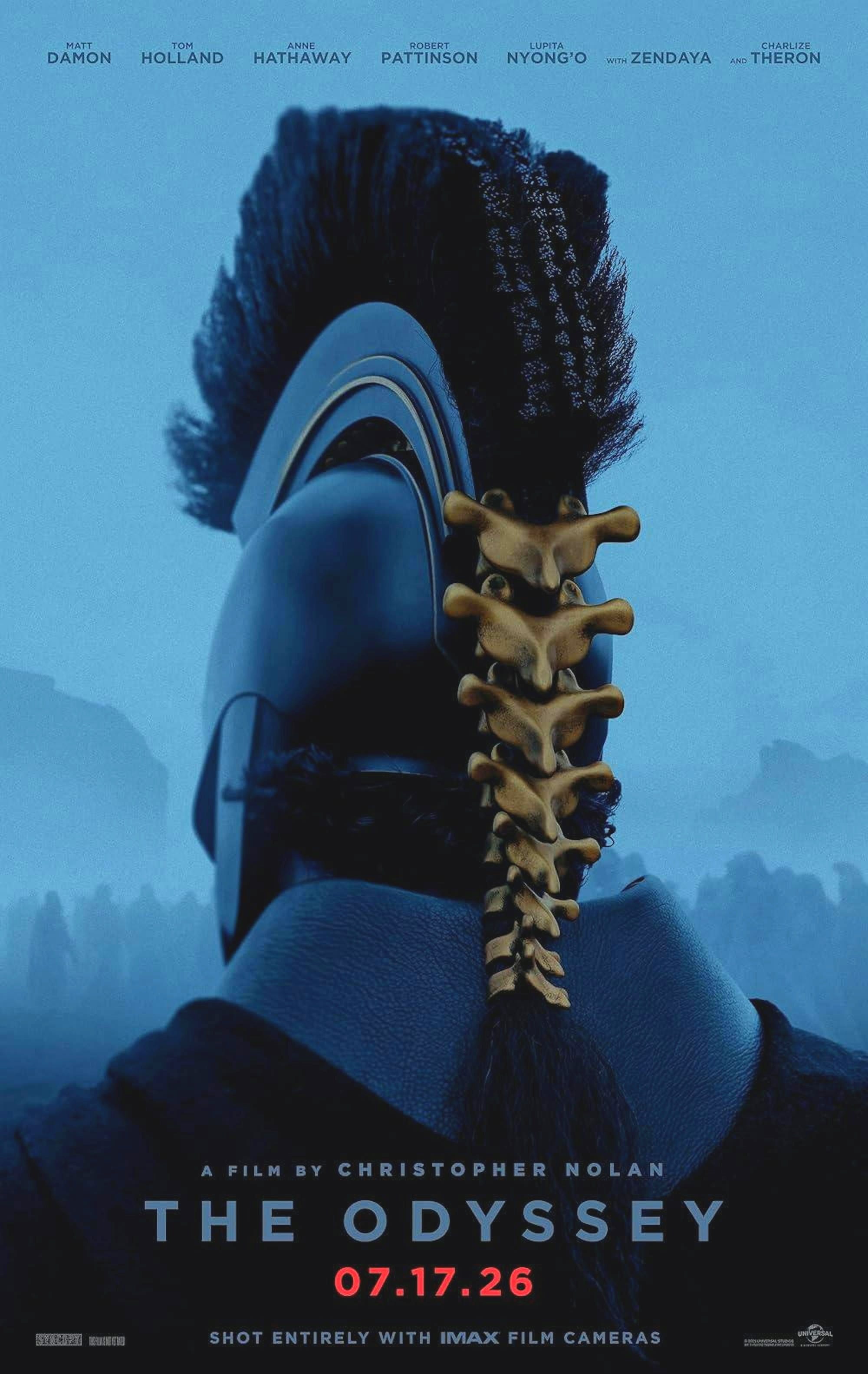
Yes, I’ve read the classics. Yes, I write mythic fiction (take a peek around the digs if you haven’t noticed). And yes, I walked out of Christopher Nolan’s The Odyssey…
…with what felt like a minor concussion in my inner ear. But! I’d still sit through it again tomorrow.
I’ll start with the noise, since the movie does. The sound design is a WEAPON. Had I known, I would have brought my festival earplugs. Then I remembered this is a story about men getting worked over by a vengeful sea god for a decade and figured a movie this big is supposed to make you feel small in front of it.
So, I’ll allow it.
Speaking of, the score itself might be the best thing in the building. Ludwig Göransson reconstructed ancient Greek instruments like the aulos and lyre instead of reaching for a standard orchestra.
I’d put this soundtrack on and let it run alongside me during a writing session. I say that about one score a decade, and it usually has Hans Zimmer’s name on it.
Performances: Hathaway IS Penelope. Damon is in the exact right era of his life to play Odysseus (weathered & tired in the right ways). Ofc Tom Holland can do no wrong in my house, though a shirtless scene would’ve been a public service. Just saying!
The one miss for me → Zendaya as Athena.
The easy complaint is that she's too young, and that’s probably the wrong complaint. Because Athena was never old (even though she’s known to appear to people in a variety of forms and ages). Athena comes into the world already grown and already armed. Ageless really. What the part actually needs is weight, the specific gravity of a mind that has outlasted empires and finds you a little tedious for still being alive. That is a hard thing to carry at any age, and I did not feel it here. The goddess of wisdom should make the hero feel watched whereas Zendaya most felt present.
And if you’re circling this post to complain about a Black Helen of Troy, save it. I’m not the audience for that conversation and neither is this space. Helen’s looks were never fixed to begin with. Herodotus has a whole version where she never even reaches Troy. Instead, she waits out the entire war in Egypt while the Greeks besiege a phantom. People have argued over this woman for millennia, so welcome to the club.
Which brings me to the thing I actually want to talk about, the thing I kept circling on the drive home.
Go into this film expecting a faithful transcription of Homer and you will spend nearly three hours quietly furious. Thus, life pro tip: expect a mash-up of The Odyssey and Virgil’s Aeneid, and that this is an adaptation (read: a different medium trying to capture the spirit of the epic poem), and the whole thing settles more into place. The Trojan horse, the single most famous image the war ever produced, barely exists in Homer. It surfaces in The Odyssey as a few lines in a song, performed by a blind bard at a feast while Odysseus quietly falls apart in the audience. That's it. The version you are picturing right now, the hollow belly full of soldiers, Sinon talking the Trojans into dragging their own doom through the gates, comes overwhelmingly from Virgil, a Roman poet writing some seven hundred years later for an empire that wanted Troy in its family tree.
Now, before the classisicts come at me with pitchforks, I know that the Greeks did tell those scenes. They had whole poems about the fall of the city, the Little Iliad, the Sack of Troy. But those poems are gone. We reconstruct them from summaries and scraps, from other people describing what they used to say. The “original” so many people are ready to defend is like a rumor of a rumor.
Nolan grafting The Aeneid onto a Greek frame is just doing what the Greeks already did to Hittite mythology, borrowing and reshaping a story until it serves its purpose.
What is canon, then, for a mythology? I genuinely don't think it is a real question. It is a modern anxiety. People are ready to sharpen their knives to defend a fixed text that was never fixed, in the name of an author who may not have been one person. I love the passion, I do. But it's hard to defend a canon when half of it never survived antiquity at all.
The change I found genuinely brave is smaller, and it lives inside Odysseus himself: the revamping of his cleverness. When I read The Odyssey, I got the sense that it was the thing worth rooting for, the reason Athena loves Odysseus in the first place. Nolan asks what that same cleverness cost the people standing closest to him when it works. I felt that shift ripple through the rest of the plot, and maybe that perspective lands better for a modern audience, even if it quietly reshapes how the whole story feels.
My one lingering want from the movie was more god, honestly. Homer’s gods are constantly in the room, causing scenes/drama/and all kinds of foolishness. Nolan strips most of them out, and maybe there’s some thematic reason I don’t feel like doing the work to figure out, because at the end of the day I just wanted a few more of them breathing down Odysseus’s neck.
